

Lombok is more connected than many investors realise.
As at July 2026, Lombok International Airport has scheduled nonstop services from 14 airports: two international gateways and 12 domestic origins across Indonesia.
The two direct international gateways are Singapore and Kuala Lumpur. The domestic network includes major entry points such as Jakarta, Denpasar, Surabaya, Yogyakarta and Makassar, alongside regional origins including Labuan Bajo, Bima, Sumbawa Besar and Waingapu.
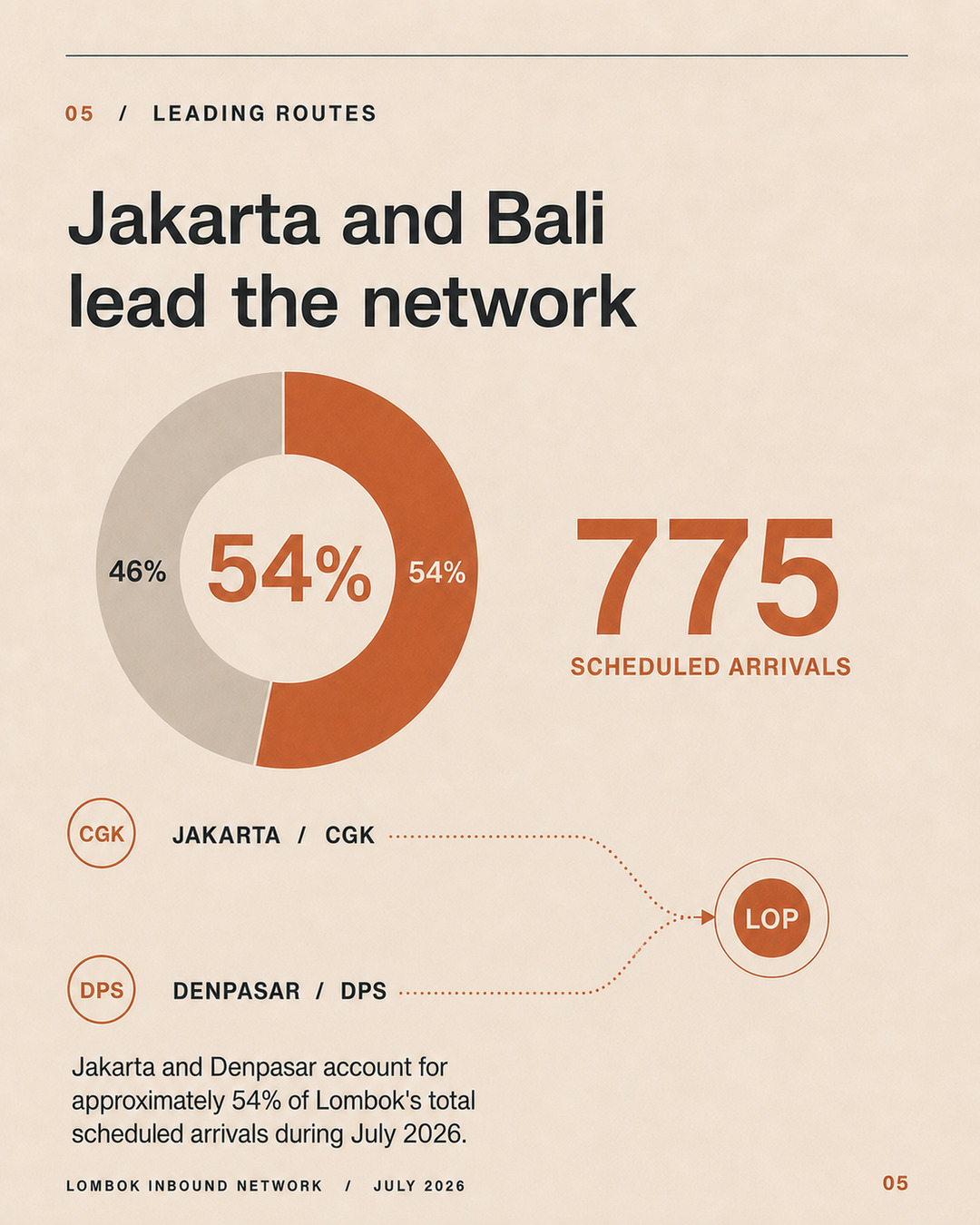
The scale of the network is also meaningful. Schedule data compiled by FlightConnections listed 1,427 flights arriving at Lombok International Airport during July 2026—approximately 48 arrivals each day. Jakarta and Denpasar alone accounted for 775 of those scheduled arrivals, or around 54% of the monthly total.
These numbers help explain how people can reach Lombok, but they should be interpreted carefully. Scheduled flights are not the same as passenger arrivals, seat capacity or hotel demand. Connectivity is one part of a destination’s investment story—not proof that an individual property will perform.
Lombok’s two direct international gateways
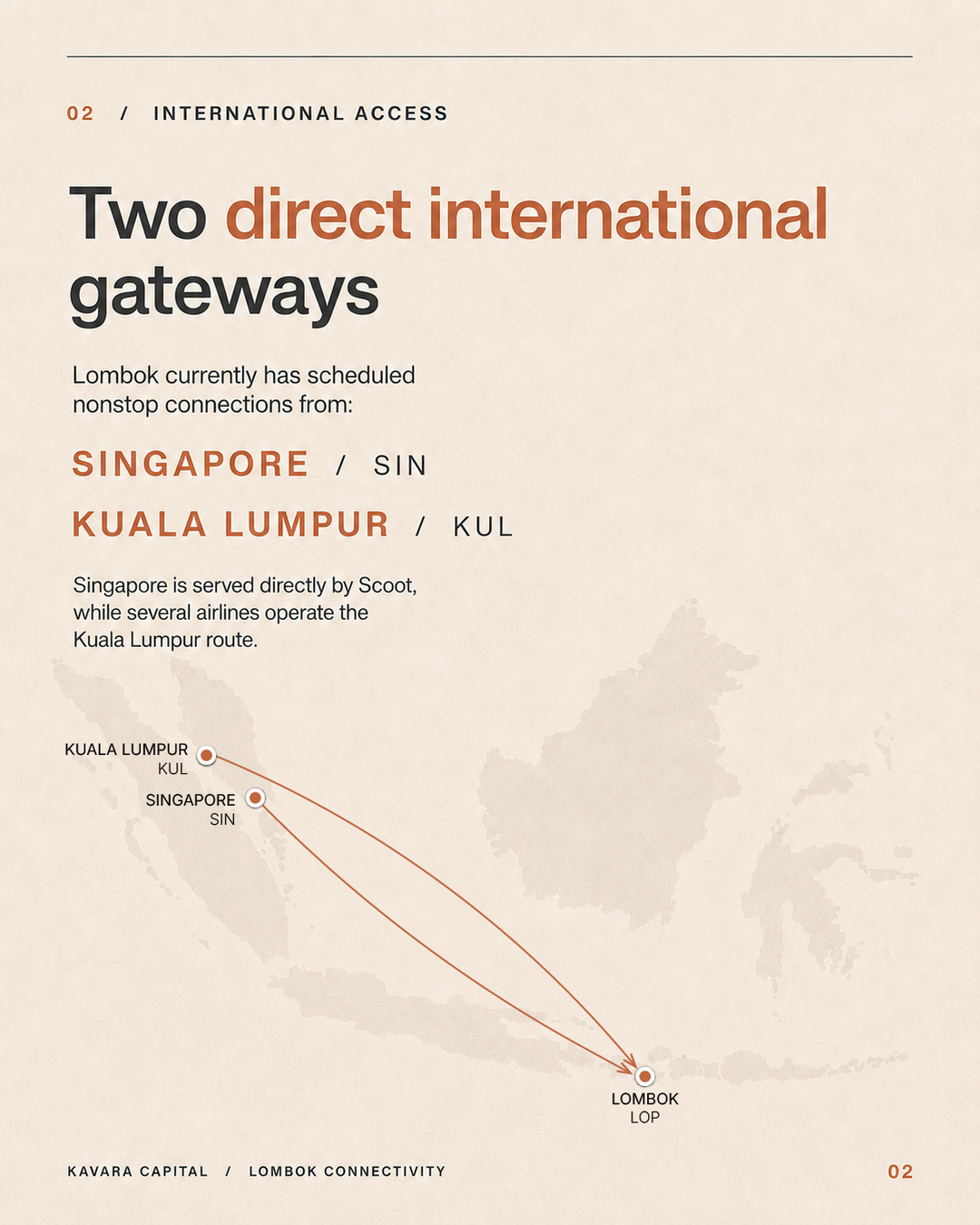
At the time of writing, Lombok has scheduled direct international services from:
| International origin | Airport | Current direct connection |
|---|---|---|
| Singapore | Changi Airport (SIN) | Direct Scoot services to Lombok |
| Kuala Lumpur | Kuala Lumpur International Airport (KUL) | Direct services operated by multiple airlines, including AirAsia-group carriers, Batik Air and Lion Air |
Singapore: regional access through a global aviation hub
Scoot currently sells direct services between Singapore and Lombok. The July 2026 schedule showed up to 10 services a week on the route, although availability and frequency vary by date.
Singapore matters for more than its resident travel market. Changi is one of Southeast Asia’s major aviation hubs, providing onward connections from Australia, Asia, Europe and other regions. A direct Singapore–Lombok service can therefore reduce the friction involved in reaching Lombok for travellers who would otherwise connect through Bali or Jakarta.
That does not mean every international visitor will use the route. Fares, schedules, connection times and traveller preferences all influence how people enter the destination. However, the service improves Lombok’s visibility and makes the island more accessible to a wider regional and international catchment.
View current Scoot Singapore–Lombok availability.
Kuala Lumpur: Lombok’s highest-volume international connection
Kuala Lumpur is currently Lombok’s other direct international gateway. July 2026 schedule data listed 66 arrivals from Kuala Lumpur, compared with 44 from Singapore.
The route is served by multiple airlines. Lion Air added a daily Lombok–Kuala Lumpur service from 28 June 2026, joining existing direct services on the city pair. This increased the depth of the route and gave travellers additional choice across schedules and carriers.
Kuala Lumpur also functions as a broader connecting hub. Travellers can reach it from cities across Malaysia and a wide international network before continuing directly to Lombok.
This distinction is important when describing Johor Bahru. Johor Bahru is part of the wider connecting network available through Kuala Lumpur, but it is not listed as a current nonstop origin to Lombok in the July 2026 route data.
Read Lion Air’s announcement of its daily Lombok–Kuala Lumpur service.
The domestic network carries most of Lombok’s scheduled air traffic
Lombok’s international links are significant, but the domestic network remains the backbone of its air connectivity.
As at July 2026, 12 Indonesian airports were listed with scheduled direct services to Lombok. These included:
- Jakarta;
- Denpasar;
- Surabaya;
- Yogyakarta;
- Makassar;
- Labuan Bajo;
- Balikpapan;
- Banyuwangi;
- Bima;
- Sumbawa Besar;
- Tambolaka; and
- Waingapu.
Some of these services are seasonal or operate only on selected days, so the existence of a route should not be confused with a daily flight.
Jakarta is the largest origin in the network. July schedule data showed 430 arrivals from Jakarta, while Denpasar accounted for 345. Together, these two routes represented approximately 54% of all scheduled arrivals into Lombok during the month.
This concentration tells us two things.
First, Lombok is well connected to Indonesia’s principal national gateway and to neighbouring Bali. Travellers who cannot access Lombok directly from their international origin can often connect through Jakarta or Denpasar.
Second, the network remains dependent on a relatively small number of high-volume routes. Connectivity should therefore be assessed not only by counting destinations, but also by examining the frequency, capacity and resilience of the routes carrying most passengers.
More than 1,400 scheduled arrivals in July 2026
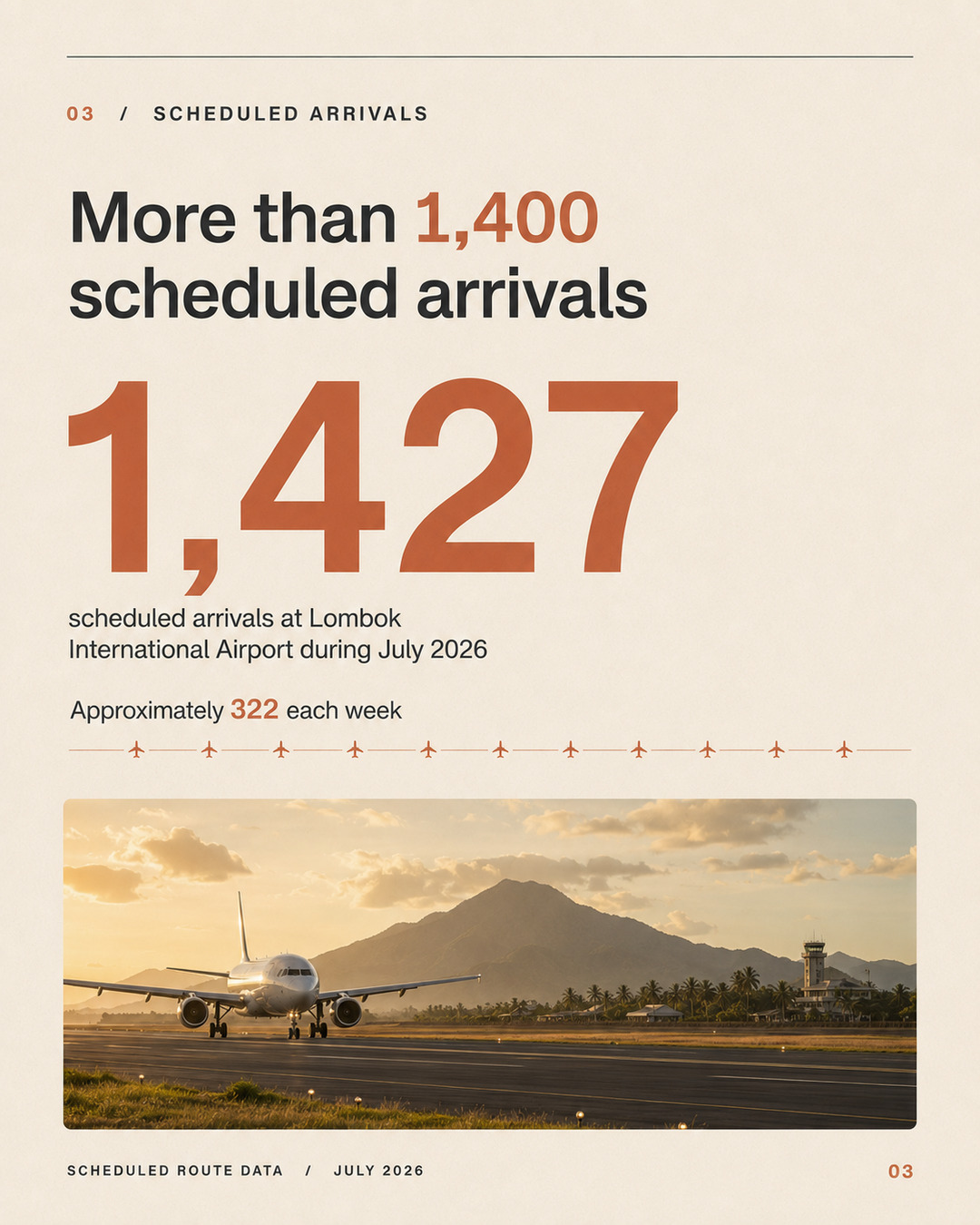
FlightConnections listed 1,427 scheduled arrivals at Lombok International Airport during July 2026. That equates to:
- approximately 48 scheduled arriving flights each day;
- roughly two scheduled arrivals per hour when averaged across the month; and
- services from 14 direct origins across Indonesia, Malaysia and Singapore.
The same schedule snapshot showed:
- Jakarta: 430 arrivals;
- Denpasar: 345 arrivals;
- Surabaya: 179 arrivals;
- Kuala Lumpur: 66 arrivals; and
- Singapore: 44 arrivals.
The Kuala Lumpur and Singapore routes together represented 110 of the 1,427 scheduled arrivals—just under 8% of the total. This reinforces an important point: Lombok’s direct international access is developing, while its domestic network currently carries most scheduled air movements.
The longest current nonstop route is Kuala Lumpur to Lombok. FlightConnections lists the route at approximately 2,058 kilometres, with a direct flight time of around three hours and five minutes.
These figures are useful indicators of network scale. They are not official passenger-arrival statistics and do not show how many seats were available, how full each flight was or why each passenger travelled.
How Lombok’s connectivity is evolving
Connectivity is not static. Airlines add, reduce or suspend routes in response to aircraft availability, seasonal demand, operating costs and commercial performance.
The launch of Lion Air’s daily Kuala Lumpur service in June 2026 is a useful example. It did not create a new international gateway—Kuala Lumpur was already connected—but it added frequency and carrier choice to an existing route.
For a destination, that can be just as important as adding another point to the map. A route operating several times each week offers more flexibility than an infrequent seasonal service. Multiple airlines on the same route can also improve schedule choice and reduce reliance on a single operator.
The evolution of Lombok’s network should therefore be assessed through several measures:
- the number of direct origins;
- weekly frequency on each route;
- whether services operate year-round or seasonally;
- the number of airlines serving the major routes;
- aircraft capacity and actual passenger loads; and
- the durability of services over time.
A newly announced route can create attention. A route that continues operating and gradually adds frequency provides stronger evidence of sustained demand.
Why connectivity matters to tourism and property demand
For tourism-led property markets, access influences how easily potential customers can reach the destination.
Improving connectivity can contribute to:
Easier visitor movement
Direct flights remove the time, uncertainty and inconvenience of an additional connection. This can make a destination more practical for shorter stays and repeat visits.
Greater destination visibility
Every route places Lombok in front of travellers searching an airline’s network. Direct access from major hubs can increase awareness among people who may not previously have considered the island.
A broader potential customer base
Singapore and Kuala Lumpur connect Lombok with regional and long-haul travel networks. Jakarta, Bali and other Indonesian cities support domestic tourism, business travel and onward international connections.
More options for accommodation operators
A broader network can help accommodation businesses reach different visitor segments. However, the benefit depends on whether the location, product, price and guest experience match the needs of those travellers.
Improved access for owners, investors and project teams
Connectivity also matters beyond tourism. More practical access can make it easier for owners, consultants, investors and operating partners to visit sites, oversee projects and maintain relationships on the ground.
What connectivity does not tell an investor
Connectivity should never be treated as a standalone investment case.
A destination can receive more flights while an individual development still underperforms because of poor location, weak positioning, unrealistic pricing, oversupply, inadequate management or excessive development costs.
Flight schedules also do not reveal:
- how many passengers are travelling for leisure;
- the length or purpose of their stay;
- which parts of Lombok they visit;
- what type of accommodation they prefer;
- how much they spend;
- whether they are first-time or repeat visitors; or
- whether accommodation supply is growing faster than demand.
For property investors, the more useful question is not simply, “Are more people able to reach Lombok?” It is:
Is the proposed property correctly located and positioned to serve a clearly understood part of that accessible market?
That requires analysis at both destination and property level.
Questions to ask when using connectivity as part of an investment assessment
When air access is used to support a tourism or property investment case, investors should ask:
- Is the route currently operating, or has it only been announced?
- How frequently does it operate, and is it seasonal?
- Has the route been maintained over several scheduling periods?
- What aircraft and approximate seat capacity are being used?
- Are passenger numbers and load factors available from an official source?
- Which visitor markets are actually using the route?
- How easily can arriving travellers reach the proposed property?
- Does the accommodation product match the needs and spending profile of those visitors?
- How much competing accommodation is entering the same market?
- Would the investment case still be sound if a route were reduced or withdrawn?
These questions place connectivity in its proper role: an enabling factor within a wider assessment of demand, location, supply, execution and risk.
What investors should watch next
Lombok’s network will continue to change. Rather than focusing only on new route announcements, it may be more useful to monitor:
- whether Singapore and Kuala Lumpur services maintain or increase frequency;
- whether additional international gateways become sustainable year-round routes;
- how domestic capacity develops through Jakarta, Denpasar and Surabaya;
- whether more airlines enter established routes;
- official airport passenger movements, not only published schedules; and
- how visitor growth is distributed across Lombok’s tourism areas.
Connectivity expands the pool of people who can reach a destination. Local positioning determines whether a particular property can participate in that demand.
Lombok is increasingly accessible—but the investment still needs to stand on its own
The July 2026 network shows that Lombok is not an isolated destination. It has direct access from Singapore and Kuala Lumpur, a broad domestic network and more than 1,400 scheduled arrivals during the month.
That improving access supports tourism movement, destination awareness and a broader potential customer base. It also provides useful context for investors assessing the island’s longer-term development.
However, connectivity is only one part of the picture. A sound property decision still depends on location, legal and investment structure, development feasibility, operating assumptions, market positioning and disciplined due diligence.
Continue your research
Explore Kavara Capital’s Investor Resources for a more structured introduction to Lombok property investment.
You can also review current Lombok opportunities or book a private consultation to discuss your objectives and potential investment pathway.
For a specific question, start a conversation with Kavara Capital.
Sources and schedule note
- FlightConnections: direct flights to Lombok International Airport — network and scheduled-arrival data, last updated 2 July 2026.
- Scoot: Singapore to Lombok booking page — current route availability checked 20 July 2026.
- Lion Air: launch of daily Lombok–Kuala Lumpur service — service effective 28 June 2026.
Airline routes, schedules and frequencies can change. Readers should confirm current services directly with the relevant airline before making travel or investment decisions.
This article provides general information only and does not constitute legal, tax, financial or investment advice. Property and development opportunities involve risk and should be assessed through appropriate independent due diligence and professional advice.