

Interest in Lombok property often begins with a simple question: where should I start?
The answer is not necessarily with a property listing.
Lombok property investment can involve several different pathways—from holding strategically located land or acquiring an individual villa to participating in a development or entering through a structured group opportunity. Each pathway can involve different capital requirements, objectives, timelines, levels of involvement and risk.
Before looking for the “best” opportunity, it is worth first understanding what kind of opportunity may be appropriate for you.
Kavara Capital’s Start Here resources bring our core investor resources, current opportunities and consultation options together in one place. They are designed to help you build context, ask better questions and choose a more informed next step.
Whether you are beginning your research or already assessing a specific Lombok opportunity, these are five practical places to start.
1. Build your foundation with the Investor Blueprint
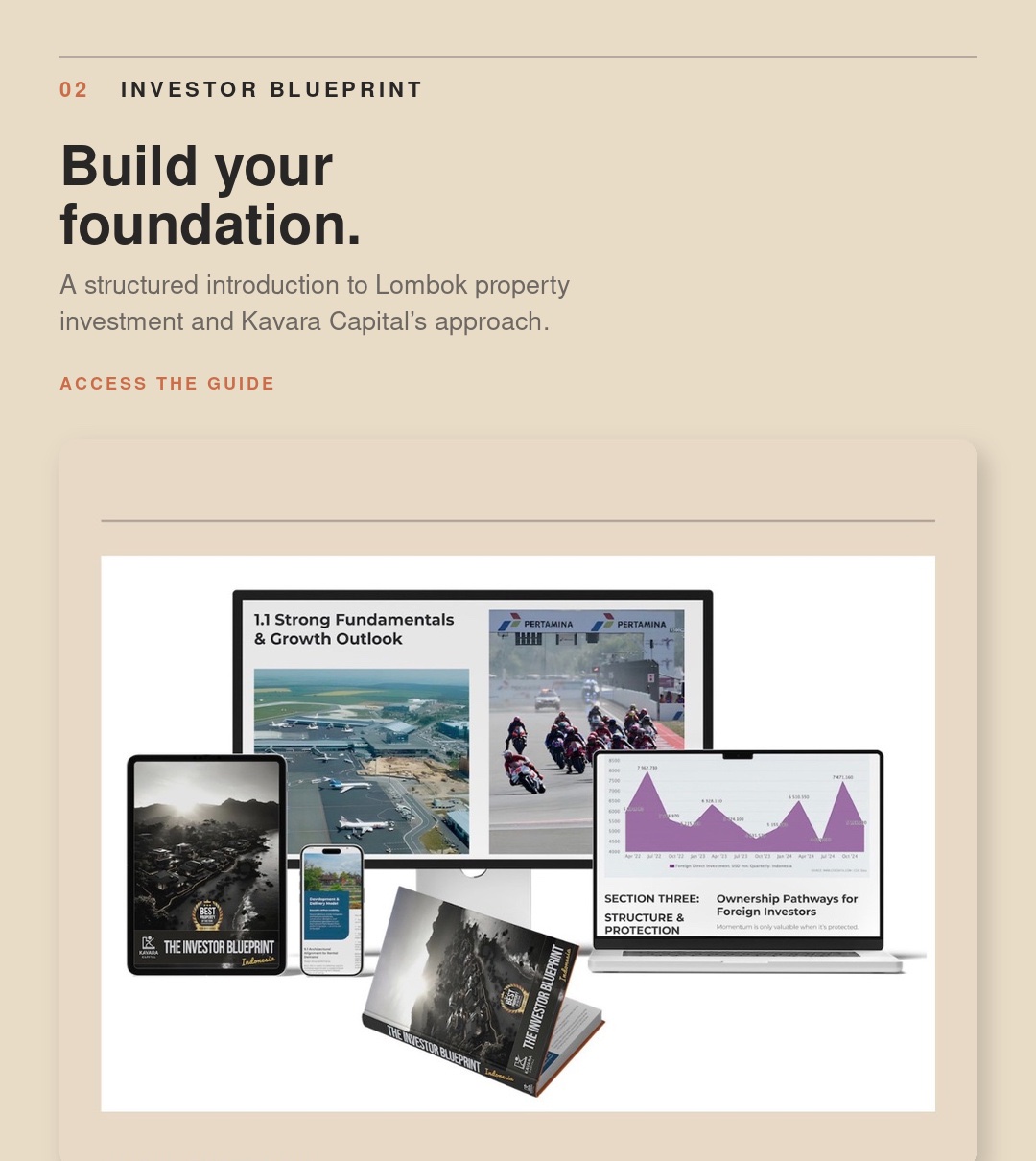
Property markets can appear straightforward from a distance. A location is growing, visitor numbers are increasing and new developments are appearing. However, a sound investment decision requires more than a positive view of the destination.
It requires an understanding of how the market works, the types of opportunities available, the structure through which an investment may be held and the factors that can affect development, operation and eventual exit.
The Kavara Capital Investor Blueprint provides a structured introduction to Lombok property investment and to the principles that shape our approach. It is intended to help investors move beyond surface-level interest and begin forming a clearer view of:
- Lombok’s wider investment context;
- the different ways investors may participate in the property market;
- the relationship between location, positioning and demand;
- ownership and investment structures that may need to be considered; and
- the importance of risk assessment and due diligence before committing capital.
The Blueprint is a useful first step if Lombok is new to you, or if your existing research has come from a collection of property listings, social media posts and informal conversations that do not yet form one clear picture.
Best starting point for: Investors who want to understand the wider market and build a more structured foundation before reviewing individual opportunities.
2. Explore whether structured small group entry suits your objectives
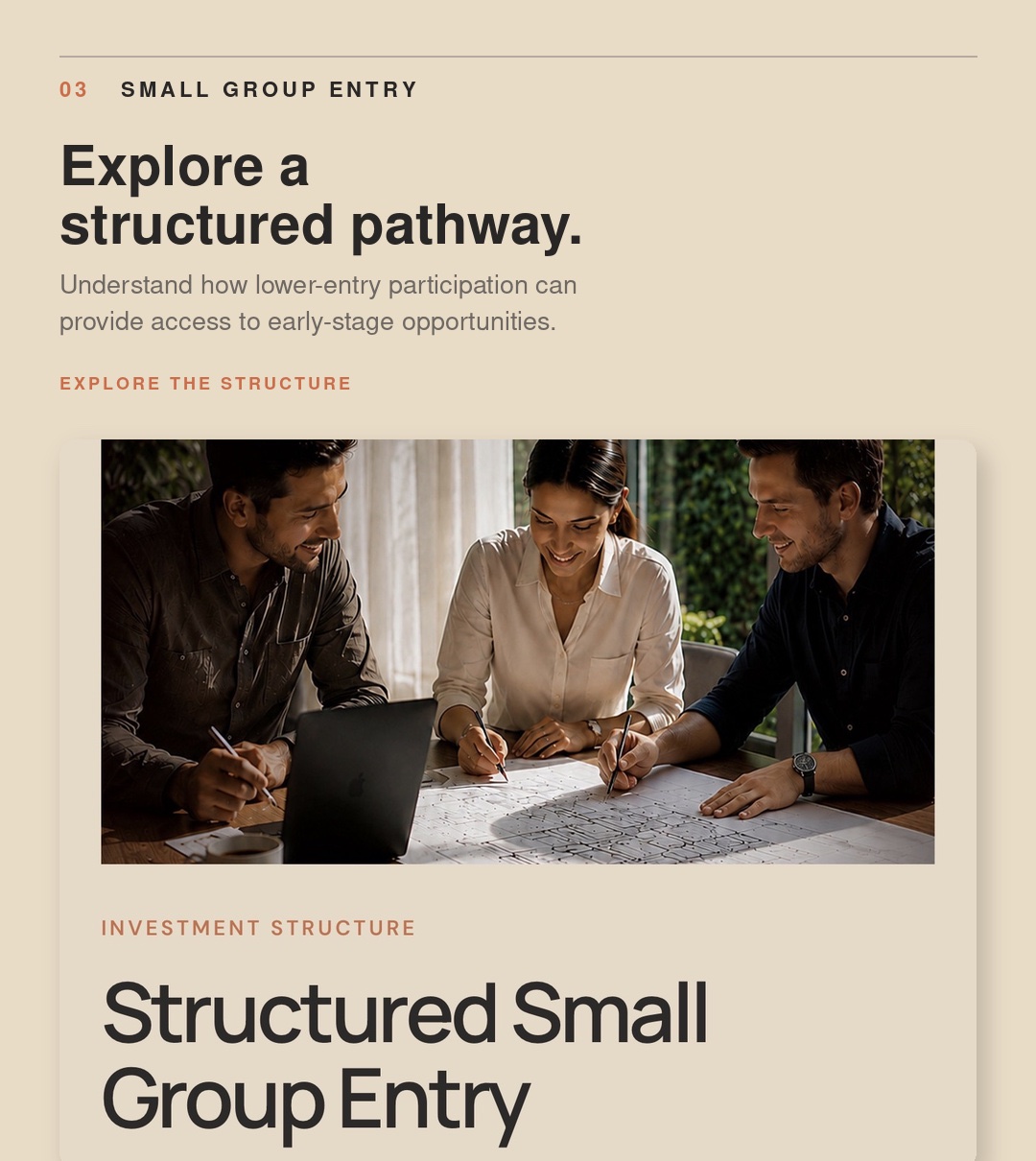
Not every investor wants—or is ready—to acquire land and fund an entire development independently.
A structured small group approach may provide another pathway. By bringing a limited number of participants into a clearly defined project or investment structure, it may be possible to access selected early-stage opportunities at a lower individual entry point than would be required for a standalone project.
The potential attraction is not simply a lower entry amount. A well-designed structure should also make the project logic easier to understand: what is being acquired or developed, how capital will be used, how decisions will be governed, what each participant holds and how potential income or value creation is expected to occur.
The structure matters as much as the underlying property. Before participating, an investor should be able to understand:
- the legal entity or agreement through which participation occurs;
- the rights and responsibilities attached to that participation;
- how project decisions are made;
- how costs, contingencies and additional capital requirements are managed;
- the intended income, hold or exit strategy; and
- the principal risks if the project takes longer or costs more than expected.
Kavara Capital’s Structured Small Group Entry overview introduces this pathway and the role it may play for investors seeking access to selected opportunities without independently undertaking a full development.
Best starting point for: Investors interested in lower-entry participation who still want a defined project, transparent structure and clear investment logic.
3. Review current opportunities—but compare more than the view
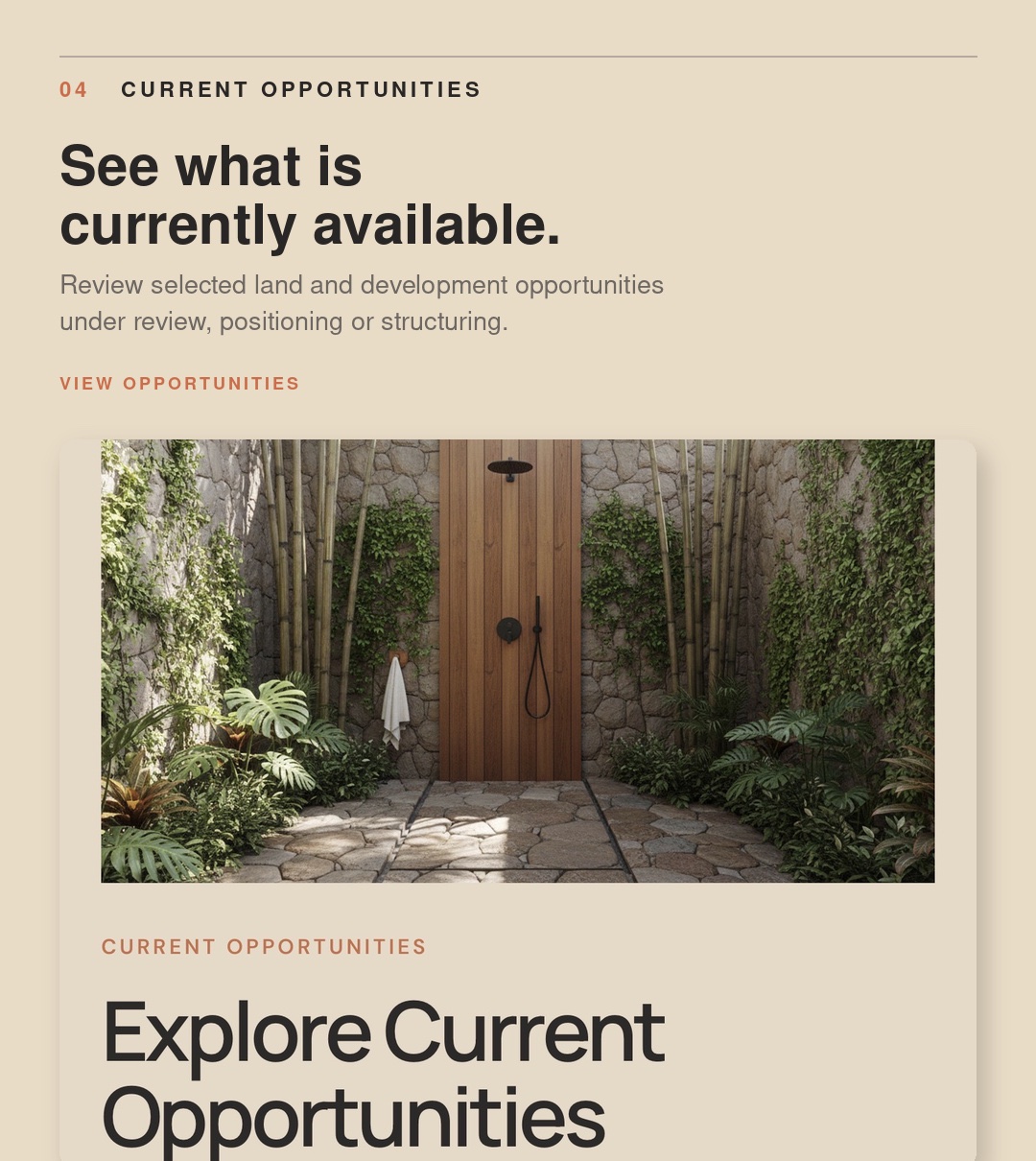
Once you understand the broader market and the pathway that may suit you, individual opportunities become easier to evaluate.
Kavara Capital’s Current Opportunities section presents selected land and development opportunities that may be under review, positioning or structuring. This can include opportunities at different stages, from strategic land through to potential villa or accommodation projects.
The purpose is not simply to display attractive sites. A strong location or ocean view can create interest, but it does not answer the questions that determine whether an opportunity is investable.
When reviewing a property, it is worth considering:
- location, access and surrounding development;
- land status, tenure and the proposed ownership or investment structure;
- planning, zoning and intended use;
- topography, infrastructure and site-preparation requirements;
- realistic construction and professional costs;
- the likely customer or end-user market;
- the operating, rental or resale strategy; and
- whether the projected return properly reflects the execution risk involved.
The right opportunity should align with the investor’s objectives—not simply create urgency because it is available.
Best starting point for: Investors who have established their criteria and are ready to compare selected land or development opportunities against them.
4. Use the 10 Questions guide to strengthen your due diligence
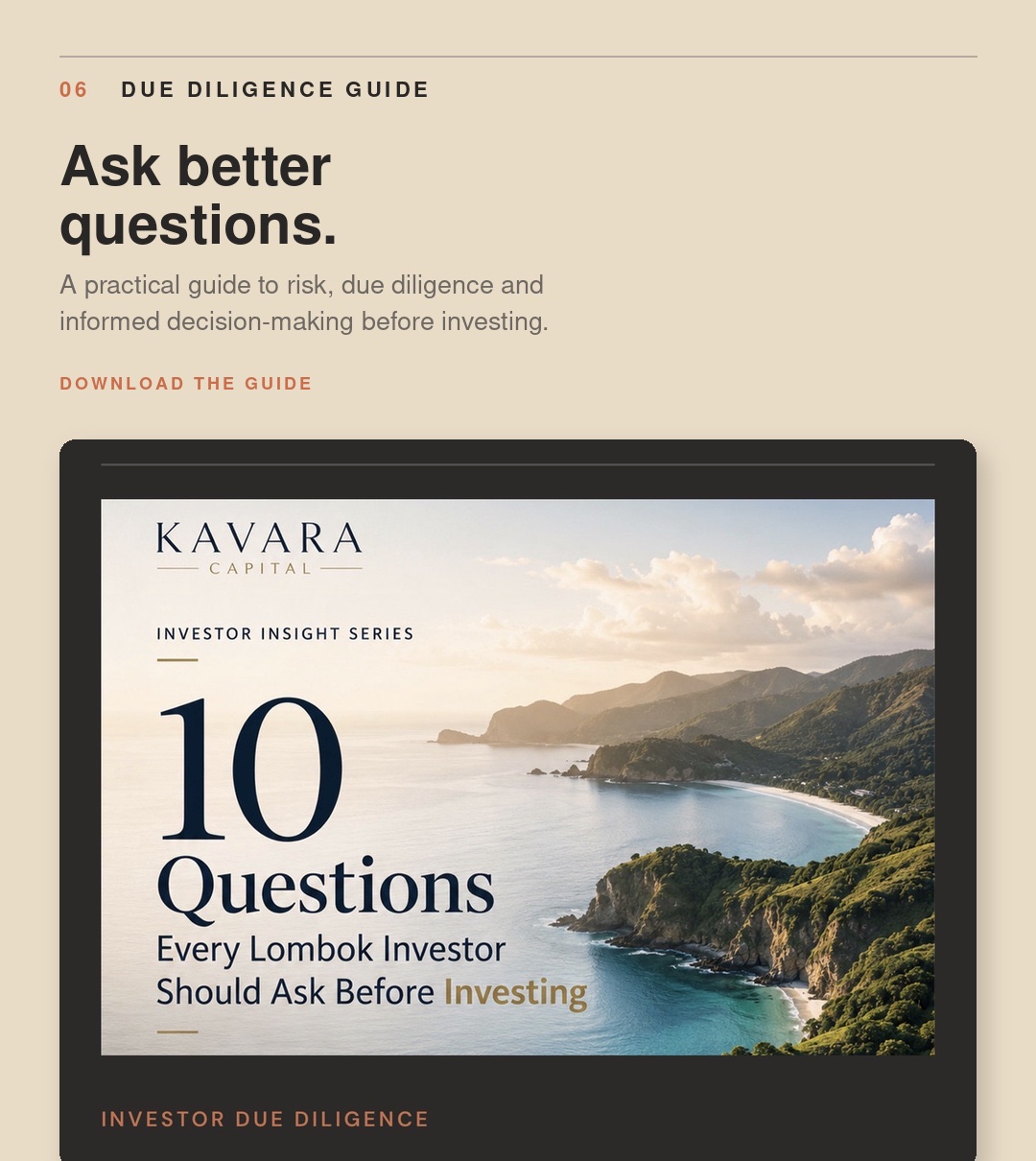
The quality of an investment decision often depends on the quality of the questions asked before it is made.
In an unfamiliar property market, it can be difficult to know what information is missing. Discussions may focus on purchase price, projected returns and location, while giving less attention to ownership, approvals, development costs, governance, operating assumptions and downside scenarios.
The 10 Questions Every Lombok Investor Should Ask Before Investing guide is designed as a practical due diligence starting point. It helps investors slow the process down, test the assumptions behind an opportunity and identify areas that may require professional legal, tax, financial or technical advice.
It can be used when reviewing a Kavara Capital opportunity or when considering another Lombok property presented elsewhere. The objective is not to make every investor an expert in Indonesian property. It is to help investors recognise the questions that should be answered by the appropriate people before capital is committed.
Best starting point for: Anyone assessing a specific opportunity or wanting a practical framework for more informed conversations with sellers, developers and advisers.
5. Book a private consultation when the question becomes personal
Guides and opportunity pages can provide context, but they cannot determine whether a particular pathway aligns with your individual circumstances.
A private consultation creates space to discuss what you are trying to achieve, the level of capital you are considering, your preferred time horizon and how actively you want to be involved. It can also help distinguish between several very different objectives, such as:
- holding land for longer-term value growth;
- developing or acquiring a villa with an income objective;
- participating in a defined small group project;
- exploring a larger accommodation or development strategy; or
- continuing to research without making an immediate commitment.
The purpose of the conversation is to identify whether there is a sensible strategic fit and what further information may be required. In some cases, the right next step may be to examine a current opportunity. In others, it may be to clarify the investment brief, conduct further due diligence or wait for a more suitable opportunity.
Best starting point for: Investors who want to discuss their objectives, assess potential fit or work through a specific opportunity in more detail.
Which starting point is right for you?
There is no requirement to follow every step in order. Your starting point depends on how far you have progressed and what you need to understand next.
| If you are… | A sensible place to begin |
|---|---|
| New to Lombok property investment | Read the Investor Blueprint and explore the Investor Resources page |
| Interested in participating at a lower individual entry point | Review Structured Small Group Entry |
| Ready to assess actual land or development options | Explore Current Opportunities |
| Already considering a particular property | Use the 10 Questions guide to structure your due diligence |
| Unsure which pathway fits your objectives | Book a private consultation |
| Not ready to book a call but have a specific question | Start a conversation with Kavara Capital |
Start with context, then assess the opportunity
Lombok continues to attract attention from investors, developers and people looking for a place to live, visit or build. That interest creates possibilities, but it does not remove the need for careful selection, appropriate structuring and disciplined due diligence.
The most useful first step is not to rush toward an available property. It is to understand the market, clarify your own objectives and establish the questions an opportunity must answer.
Kavara Capital’s investor resources have been brought together to help you do exactly that.
This article provides general information only and does not constitute legal, tax, financial or investment advice. Property and development opportunities involve risk and should be assessed through appropriate independent due diligence and professional advice.